Introduction
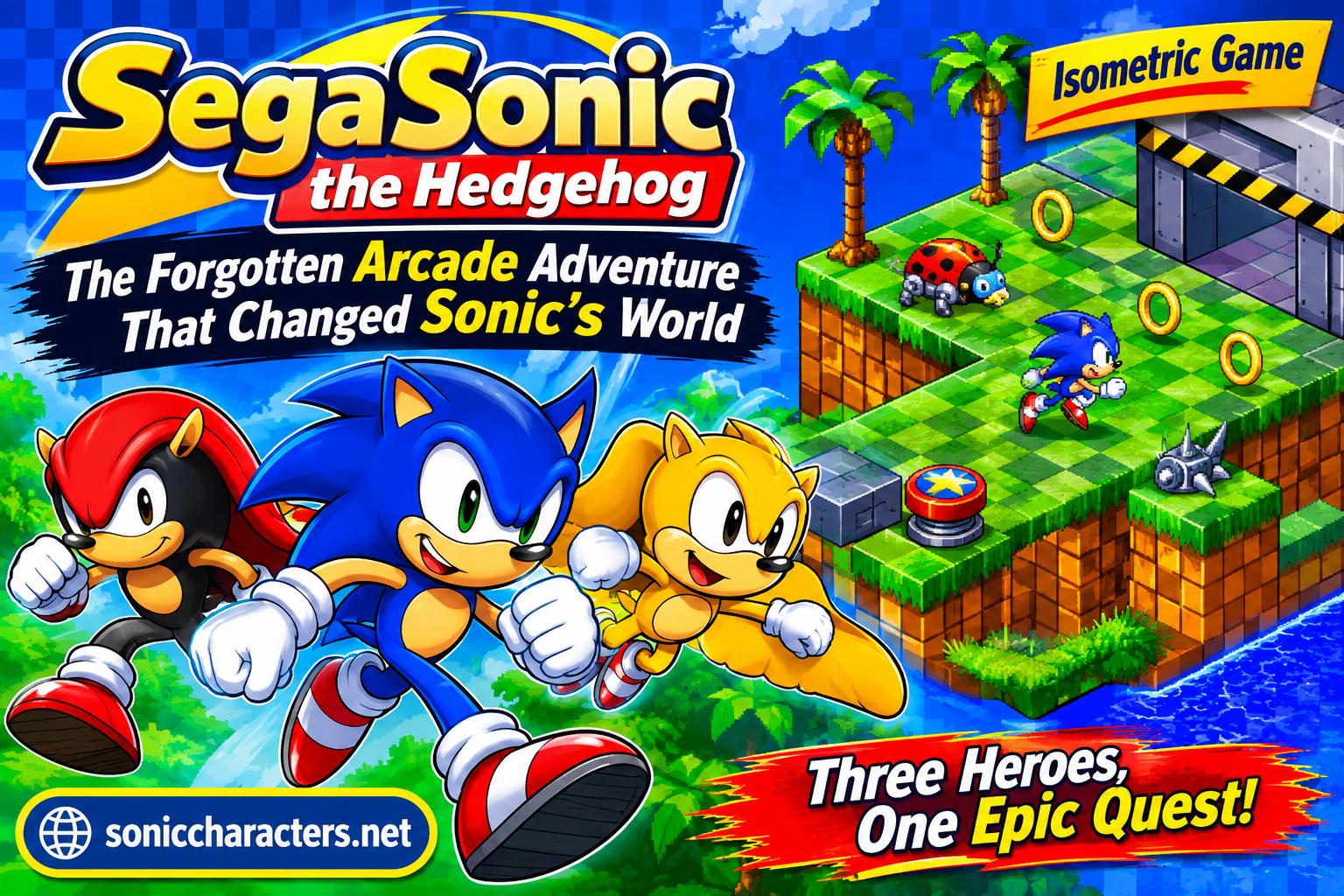
When people think about classic Sonic games, they usually remember colorful worlds, fast-running characters, challenging obstacles, and memorable music. The original Sega Genesis adventures established a recognizable style that helped make Sonic one of gaming’s most popular characters. However, not every Sonic adventure followed the traditional formula. One unusual release took the familiar blue hedgehog into a completely different direction by introducing an arcade experience built around three playable characters, rolling controls, and an angled visual perspective.
Released in 1993, SegaSonic the Hedgehog offered something different from the home console games of its generation. Instead of relying on a traditional directional pad, the arcade cabinet used trackball controls that allowed players to guide their characters through dangerous environments. Its unusual presentation made it stand out among other platform titles, while its cooperative gameplay created an exciting experience for friends visiting an arcade together.
The game is especially interesting because it combines familiar Sonic elements with the design of an isometric game. Players must move quickly, avoid environmental dangers, collect valuable rings, and reach the end of each stage before their health runs out. Although its controls and perspective make it feel different from traditional Sonic adventures, the central idea remains familiar: keep moving, react quickly, and survive whatever Dr. Eggman places in the way.
Even decades after its arcade debut, this unusual title continues to attract attention from classic gaming enthusiasts. Its distinctive gameplay, memorable characters, and experimental design make it an important part of Sonic history.
The Story Behind SegaSonic the Hedgehog
The adventure begins when Sonic and two of his companions become trapped on an island controlled by Dr. Eggman. The villain has prepared a dangerous environment filled with mechanical traps, dangerous creatures, and obstacles designed to prevent anyone from escaping. Rather than simply fighting their way through a traditional level, the heroes must navigate a series of challenging courses to survive.
The basic story is easy to understand, but it provides enough motivation to keep players moving. Every area introduces another threat, and the characters cannot afford to waste too much time. The journey eventually leads toward Eggman’s main base, where the final challenge awaits.
This setup works particularly well for an arcade environment. Players can understand the objective almost immediately without reading a lengthy explanation. Escape the island, avoid the traps, collect rings, and keep moving toward safety.
The game’s story also gives the experience a different atmosphere from the usual side-scrolling adventures. The angled camera reveals more of the surrounding environment, making every course feel like a small obstacle-filled arena rather than a conventional horizontal stage.
Three Playable Characters With Different Personalities
One of the most interesting features is the opportunity to play as three characters. Sonic shares the adventure with Mighty the Armadillo and Ray the Flying Squirrel. Although their appearances and personalities are different, they use the same basic controls and abilities.
Sonic the Hedgehog
Sonic is the most recognizable character in the group. Known for his speed and confident personality, he naturally fits an adventure where reaching the finish line quickly is important. Players familiar with his previous games will recognize his energetic movements and signature spin attack.
However, controlling Sonic in an isometric game requires a slightly different approach. Instead of simply moving left or right, players must guide him across a course presented from an angled perspective. Understanding the direction of movement is essential when approaching narrow paths, moving platforms, and dangerous traps.
Mighty the Armadillo
Mighty is another memorable character introduced through this arcade adventure. His appearance gives him a distinctive identity, while his straightforward abilities make him easy to understand.
Although he does not have a completely separate moveset, choosing Mighty provides an alternative way to experience the same stages. Players who enjoy discovering lesser-known Sonic characters may find his appearance particularly interesting.
Ray the Flying Squirrel
Ray completes the trio. His cheerful appearance and flying squirrel design make him visually different from Sonic and Mighty. He adds another recognizable personality to the adventure and gives players a chance to explore a relatively uncommon character from the franchise.
The three heroes share the same general gameplay abilities, so selecting a character is largely a matter of personal preference. This approach also makes multiplayer sessions easier to understand because every participant follows the same basic rules.
What Makes the Gameplay Different?
The biggest difference between SegaSonic the Hedgehog and many other classic Sonic titles is its control system. Traditional console games usually depend on directional buttons or a joystick. This arcade release uses a trackball instead.
Players roll the trackball to control movement, allowing them to guide their character in different directions. The speed and direction of the rolling motion influence how the character travels through the environment. A separate action button allows the player to jump and perform an attacking spin.
This design creates a physical connection between the player and the character. Rather than simply pressing a direction, the player must actively roll the control mechanism to produce movement.
The result is an isometric game experience that feels more hands-on than a typical platform adventure. Players need to understand how quickly their character responds and how much movement is required to avoid an approaching obstacle.
At first, the control system may feel unusual, especially for someone accustomed to traditional Sonic games. However, learning the relationship between trackball movement and character speed becomes part of the challenge.
Understanding the Isometric Perspective
The visual perspective is another important part of the game’s identity. Instead of showing the action from a straightforward side view, the camera presents the environment from an elevated diagonal angle.
This style creates the appearance of depth while keeping the gameplay within a two-dimensional framework. Paths, platforms, gaps, and environmental objects can be seen from a viewpoint that resembles a three-dimensional space.
An isometric game often uses this presentation to make environments look more detailed without requiring fully three-dimensional graphics. In SegaSonic, the technique allows designers to build courses that contain different movement directions and obstacles.
The perspective also affects how players judge distances. A gap that looks close on the screen may require more careful movement than expected. Similarly, approaching a trap from a diagonal direction can demand quick adjustments.
For this reason, players must pay attention to the entire course rather than concentrating on the character alone. Recognizing the shape of a path and predicting where the next hazard might appear can make a significant difference.
The Trackball Control System Explained
The trackball is arguably the most memorable part of the arcade cabinet. It replaces the familiar directional joystick with a large rolling mechanism that responds to physical movement.
Each player has a dedicated control arrangement. The original cabinet uses color-coded controls for the three characters, helping players identify their stations during multiplayer sessions.
The trackball controls movement, while the action button handles jumping. When players move and jump at the right moment, their characters can perform a spinning attack that helps them deal with enemies.
This combination gives the controls a simple structure, but mastering them requires practice. Moving too quickly can make it difficult to avoid hazards, while moving too slowly can leave a character exposed to approaching dangers.
In an isometric game, accurate directional control is especially important because the character may need to move diagonally across the screen. SegaSonic makes this idea central to its gameplay rather than treating it as a minor feature.
The control scheme also explains why the game is closely associated with its original arcade hardware. A conventional controller does not automatically reproduce the physical experience of rolling a trackball.
Dangerous Traps and Environmental Challenges
Eggman’s island is filled with obstacles that make every stage unpredictable. Players encounter environmental dangers that require quick reactions and careful movement.
Some of the most recognizable threats include giant rolling boulders, lava flows, mechanical gears, falling stalactites, and unstable sections of the environment. These hazards create constant pressure because waiting too long can be just as dangerous as moving in the wrong direction.
Boulders can threaten players by rolling across the course. Lava introduces another type of danger, forcing players to find a safe route before the environment becomes impossible to cross. Mechanical traps add timing challenges, while collapsing paths demand quick decisions.
These elements make every isometric game level more than a simple race toward the finish line. Players must study the environment, identify safe areas, and decide when to accelerate or change direction.
The variety of obstacles also prevents the adventure from becoming repetitive. Even though the basic objective remains consistent, different hazards require different reactions.
Rings, Health, and Survival
Rings have always been an important part of Sonic’s identity, and this arcade adventure gives them an additional purpose. They are not simply decorative collectibles or a way to increase a final score.
Collecting rings can help restore health after the player takes damage. This makes them valuable resources during difficult sections of the game.
Players should pay attention to rings scattered around the courses instead of focusing entirely on reaching the exit. Taking a slightly different route to collect useful items may provide an advantage later in the stage.
The health system also changes how players approach danger. A single mistake does not necessarily end the adventure immediately, but repeated damage can eventually become a serious problem.
This creates an interesting balance between speed and survival. Moving quickly can help players escape certain hazards, but careless movement may cause unnecessary damage.
The design encourages players to think about their next move instead of relying entirely on speed. A successful isometric game experience depends on understanding when to move aggressively and when to prioritize safety.
Seven Stages of Arcade Action
The adventure takes players through seven stages, each offering its own environmental challenges and progression toward Eggman’s base.
The different areas introduce new obstacles and keep the experience visually interesting. Players must adapt as the environment changes, because a strategy that works in one section may not be effective in another.
Some stages emphasize escaping environmental dangers, while others require more attention to movement and timing. The changing surroundings provide a sense of progression throughout the adventure.
The final stages increase the pressure as players approach the villain’s main location. Reaching the end is not simply a matter of surviving every obstacle; players must also remain alert when the final escape sequence begins.
This stage-based structure is ideal for an isometric game designed for arcade sessions. Each section provides a manageable challenge while contributing to a larger adventure.
Multiplayer Makes the Experience More Exciting
Another major feature is multiplayer support. Up to three players can participate at the same time, with each person controlling one of the available characters.
This creates an enjoyable cooperative atmosphere. Instead of watching one player complete the entire adventure, friends can take part in the same challenge and experience the dangers together.
Multiplayer also changes the atmosphere of the arcade cabinet. Players can encourage each other, react to unexpected obstacles, and celebrate successful escapes.
The shared experience makes the game particularly suitable for groups. Even someone unfamiliar with the Sonic franchise can understand the basic objective after watching a short demonstration.
The cooperative format is one reason the game remains interesting to arcade enthusiasts. It offers something different from the usual single-player platform experience.
Visual Presentation and Arcade Atmosphere
For a game released in 1993, SegaSonic offers a distinctive visual style. The characters are colorful, the environments contain recognizable details, and the angled camera creates a sense of depth.
The animation helps maintain the energetic personality associated with Sonic. Characters move quickly, react to obstacles, and perform their attacks in a way that keeps the action lively.
The environmental presentation also contributes to the challenge. Players need to recognize hazards as they appear and understand how those objects relate to the path ahead.
The overall experience demonstrates how an isometric game can create a different visual identity without completely abandoning familiar platforming mechanics.
The arcade presentation is also important. Bright visuals, energetic action, and multiplayer controls make the cabinet attractive to people looking for a quick but challenging gaming session.
Why SegaSonic the Hedgehog Was So Unusual
During the early 1990s, most Sonic adventures followed a recognizable format. Players moved through side-scrolling stages, collected rings, defeated enemies, and searched for hidden areas.
This arcade title experimented with a different approach. Its trackball controls, diagonal perspective, and three-player setup made it stand apart from the console releases.
The decision to build an isometric game around physical arcade controls was an interesting design choice. It gave the developers an opportunity to experiment with movement in a way that would have been difficult to reproduce using a standard controller.
The game also demonstrated that the Sonic universe could support different styles of gameplay. The characters did not need to remain limited to the traditional side-scrolling formula.
Although the title did not become as widely recognized as the main console releases, its unusual mechanics helped give it a special place in arcade history.
Why Has the Game Remained Difficult to Access?
One reason SegaSonic the Hedgehog attracts curiosity is its limited availability compared with many other Sonic titles.
The original release was an arcade game, and its unusual control system created practical difficulties when considering a home console conversion. A standard controller cannot perfectly recreate the movement of a dedicated trackball.
This technical difference became an important part of the game’s legacy. While many classic arcade games eventually received straightforward home versions, SegaSonic remained closely associated with its original hardware.
Fans interested in experiencing the game often look for arcade recordings, gameplay demonstrations, and preservation projects. These resources help introduce the title to people who never had an opportunity to visit an arcade during its original release period.
The situation also makes the game interesting to collectors and historians. It represents a different period in gaming, when developers experimented with specialized hardware to create experiences that were difficult to reproduce elsewhere.
The Legacy of Mighty and Ray
Sonic, Mighty, and Ray give the game an important place in the wider franchise because it introduced two characters who were less familiar to mainstream audiences.
Mighty later appeared in Knuckles’ Chaotix, while Ray eventually returned in later Sonic-related releases. Their appearances helped keep interest in the arcade adventure alive among fans who enjoy exploring the franchise beyond its most famous characters.
These characters also demonstrate how the Sonic universe expanded during the 1990s. Developers were experimenting with different personalities, designs, and gameplay possibilities.
For longtime fans, seeing Mighty and Ray together with Sonic is one of the most appealing aspects of the experience. The trio gives the adventure its own identity rather than making it feel like another ordinary Sonic release.
How SegaSonic Compares With Other Sonic Adventures
Comparing this title with traditional Sonic games reveals how much the gameplay formula can change while keeping the same recognizable characters.
Classic side-scrolling titles emphasize horizontal movement, jumping between platforms, and building momentum through carefully designed stages. SegaSonic replaces that familiar structure with an angled viewpoint and trackball-based movement.
The differences are noticeable from the beginning. Players must think about direction differently, respond to hazards from multiple angles, and learn how physical control movement affects their characters.
An isometric game can create a different kind of platforming challenge because the player needs to interpret the environment from another viewpoint. This does not automatically make the experience easier or harder; it simply changes the skills required to play effectively.
SegaSonic also emphasizes cooperative play more directly than many of the earlier console adventures. Having three playable characters available at once gives groups another reason to explore the game.
Is SegaSonic the Hedgehog Worth Exploring Today?
For fans of classic arcade gaming, the answer is certainly worth considering. The game offers a fascinating example of how developers experimented with established characters and familiar gameplay ideas.
Its trackball controls may feel unusual to modern players, but that difference is part of its appeal. Instead of copying the traditional Sonic formula, it presents a new way to experience the characters.
The short stage structure, cooperative gameplay, and environmental hazards make it an interesting title to watch or explore through preservation material.
Anyone interested in the development of an isometric game can also learn something from its design. It demonstrates how perspective, input devices, and level layouts work together to create a recognizable gaming experience.
The game may not be the most accessible entry in the franchise, but it remains a memorable example of arcade experimentation.
Final Thoughts
SegaSonic the Hedgehog deserves attention because it took a familiar gaming universe and presented it through an unusual arcade format. Its three playable characters, trackball controls, angled environments, and dangerous obstacle courses created an experience that was different from the main Sonic releases.
The game also shows why experimentation matters in video game development. Not every unusual idea becomes a mainstream success, but some projects become memorable precisely because they attempt something different.
Whether someone discovers it through arcade history, character research, or an interest in classic platformers, SegaSonic provides an entertaining look at an overlooked chapter of the franchise.
Its distinctive approach to the isometric game format remains one of its most recognizable features. More importantly, the adventure reminds players that great gaming experiences can come from unexpected combinations of familiar characters, creative environments, and unconventional controls.