
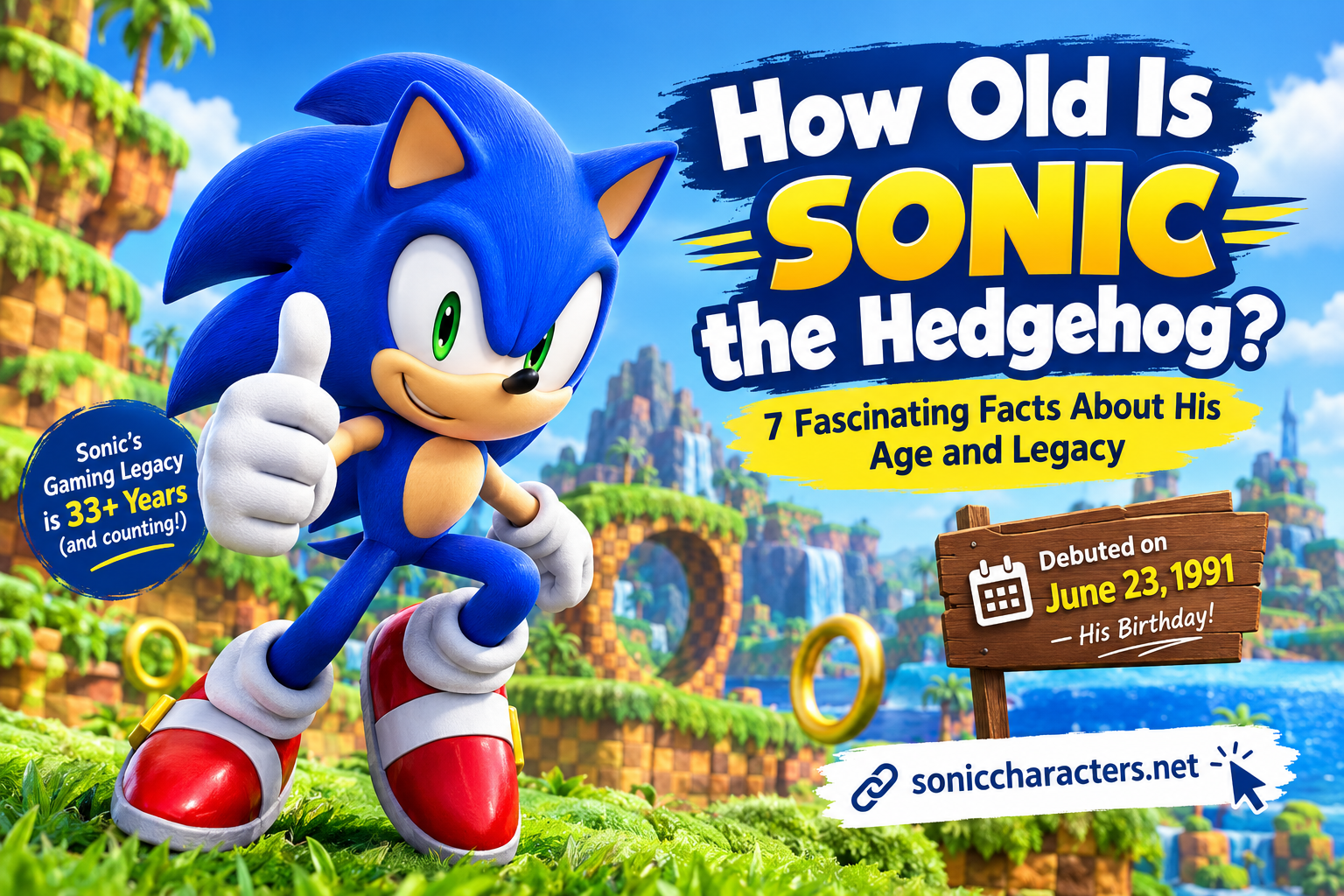
Sonic the Hedgehog is one of the most recognizable characters in video game history. With his bright blue spikes, red shoes, confident personality, and incredible speed, he has entertained generations of gamers. Since his debut in 1991, Sonic has appeared in video games, animated series, comics, movies, and countless other forms of entertainment. Yet one question continues to interest longtime fans and new players alike: how old is Sonic the Hedgehog ?
The answer depends on whether you mean Sonic’s official character age or the number of years since his first game was released. These are two different things, and understanding the difference makes his history even more interesting.
On September 7, 2024, Sonic was already closer to 34 years since his original game debut than 33. His first major game, Sonic the Hedgehog, launched in North America and Europe on June 23, 1991. That release date is also celebrated as Sonic’s birthday.
Let’s explore his official age, gaming history, personality, friendships, and the reasons he remains popular after more than three decades.
1. How Old Is Sonic the Hedgehog in 2024?
To answer how old is Sonic the Hedgehog, it is important to separate his fictional age from his real-world history as a gaming character.
According to older official SEGA character profiles, Sonic is 15 years old. This age describes the character within the game universe rather than the length of time the franchise has existed. Sonic’s youthful personality, adventurous attitude, and love of freedom fit the image of a teenage hero who would rather explore the world than sit still.
However, Sonic’s first major video game appeared in 1991. By June 23, 2024, the original game had reached its 33rd anniversary. By September 7, 2024, approximately 33 years and two and a half months had passed since that launch.
That means Sonic’s gaming legacy was approaching its 34th anniversary in September 2024, even though his traditional character profile listed him as 15.
This distinction explains why different websites sometimes provide different answers. One may discuss the age assigned to Sonic in his fictional world, while another calculates the years since his introduction to players.
2. When Is Sonic the Hedgehog’s Birthday?
Sonic’s birthday is celebrated on June 23. The date connects directly to the original Sonic the Hedgehog game, which launched for the Sega Genesis in North America on June 23, 1991.
The first game introduced players to a fast-moving blue hedgehog determined to stop Dr. Robotnik from capturing innocent animals and using them in his machines. The combination of speed, colorful environments, memorable music, and accessible gameplay helped the character stand out in the early 1990s gaming market.
SEGA continues to recognize June 23 as Sonic’s birthday. Fans often mark the occasion by sharing artwork, revisiting classic games, discussing favorite adventures, and celebrating the franchise online.
For anyone wondering how old is Sonic the Hedgehog, his birthday provides a simple way to calculate the franchise milestone. In 2024, the character’s first major game was 33 years old, while the 34th anniversary was still ahead.
The date also demonstrates how a single video game release can become an annual celebration for a worldwide community.
3. How Sonic Became SEGA’s Famous Blue Mascot
Sonic was created during a period when SEGA wanted a memorable character who could represent its gaming identity. The company needed a hero who looked distinctive, felt energetic, and could support a new style of platform gaming.
Speed became the central idea behind the character. Instead of moving slowly through levels, Sonic raced through colorful landscapes, collected rings, defeated enemies, and jumped across obstacles. This approach made movement itself one of the most exciting parts of the experience.
His blue appearance also helped establish a recognizable visual identity associated with SEGA. His red shoes, expressive eyes, and pointed spikes made him easy to identify even in small game sprites.
The original game placed Sonic on South Island, where Dr. Robotnik had captured animals and transformed them into robotic enemies. Sonic’s mission was to defeat the villain, rescue the animals, and collect the Chaos Emeralds.
These basic ideas became important elements of the wider franchise.
Although many players focus on how old is Sonic the Hedgehog, his influence is equally interesting. The character helped SEGA establish a strong identity during the 16-bit console era and eventually became one of the best-known figures in gaming culture.
4. Why Sonic’s Official Age Is Different From His Franchise Age
A fictional character does not necessarily grow older at the same rate as the real world. Sonic is a good example of this storytelling approach.
Older official SEGA profiles list Sonic as 15 years old. However, the franchise has continued for decades, introducing new locations, villains, allies, powers, and adventures without consistently advancing his age.
This allows younger audiences to connect with the character while longtime fans continue enjoying familiar elements. Sonic can remain an energetic teenage hero even when the games themselves span more than 30 years.
Consider the difference between these two measurements:
- Character age: Older official profiles describe Sonic as 15 years old.
- Franchise age: His original major game launched on June 23, 1991, making the game series more than 33 years old by September 2024.
The distinction becomes particularly important when comparing Sonic across different media. The games, animated shows, comics, and live-action films do not always follow identical continuity or character details.
Therefore, when someone asks how old is Sonic the Hedgehog, the most useful answer explains both meanings instead of giving a single number without context.
5. Seven Interesting Facts About Sonic the Hedgehog
Sonic’s history includes several details that help explain his lasting popularity. Here are seven facts worth knowing.
Fact 1: His Birthday Is June 23
June 23 is associated with the North American and European release of the original 1991 game. SEGA celebrates the date as Sonic’s birthday, and fans use it as an annual opportunity to recognize the character.
Fact 2: Sonic First Became Famous Through Speed
Fast movement was central to the original game’s identity. Players could build momentum, race through loops, and explore stages at a pace that distinguished Sonic from many traditional platform heroes.
Fact 3: Dr. Robotnik Became His Signature Rival
Dr. Robotnik, also known as Dr. Eggman, is one of Sonic’s most recognizable enemies. The villain’s machines and plans regularly provide the conflict that drives Sonic’s adventures.
Fact 4: Rings Are a Defining Gameplay Feature
Golden rings are among the most familiar symbols in Sonic games. They serve an important gameplay purpose by protecting Sonic from certain hits when he has rings available, although specific mechanics vary between titles.
Fact 5: Tails Became One of His Closest Friends
Miles “Tails” Prower joined the series in Sonic the Hedgehog 2 in 1992. His twin tails allow him to fly, and his intelligence and loyalty make him a valuable partner during adventures.
Fact 6: Sonic Expanded Beyond Video Games
Sonic has appeared in animated television programs, comic books, merchandise, and feature films. These different formats have introduced the character to audiences who may never have played the original Genesis game.
Fact 7: His Popularity Has Lasted for Decades
Many gaming characters become less prominent after their original releases. Sonic, however, has continued to receive new games and other entertainment projects, keeping his world familiar to both returning fans and younger audiences.
These details offer more context than the question how old is Sonic the Hedgehog alone. They show how his personality, design, and gameplay have helped maintain interest in the franchise.
6. How Sonic’s Friends and Enemies Keep the Series Interesting
Sonic’s world is much larger than one blue hedgehog running through levels. The supporting characters contribute different abilities, personalities, and storylines that make each adventure more engaging.
Tails is the clever inventor and flying companion who often helps Sonic overcome difficult situations. Knuckles the Echidna is powerful, determined, and closely connected to the Master Emerald. Amy Rose brings enthusiasm and courage, while Shadow the Hedgehog offers a darker personality and a complicated relationship with Sonic.
Dr. Eggman remains a central source of conflict. His inventions frequently create dangerous machines, robotic enemies, and environmental challenges that Sonic must overcome.
These relationships give the games more variety than a simple race from one level to another. Players can become interested in character rivalries, friendships, special abilities, and the different motivations behind each adventure.
The franchise also introduces new characters and alternate versions of familiar heroes across games and other media. Although not every appearance belongs to the same continuity, these variations allow creators to explore fresh stories while preserving the essential identity of Sonic.
His age becomes less important than the qualities that define him: freedom, confidence, loyalty, and a willingness to help others.
7. Why Sonic Still Appeals to New Generations
More than three decades after his first major game release, Sonic continues to attract players because his core appeal is easy to understand. He moves quickly, faces recognizable challenges, and rarely allows a powerful enemy to intimidate him.
The gameplay has also evolved. Early titles focused on two-dimensional platforming, while later releases experimented with three-dimensional environments, exploration, racing, action, and different storytelling approaches.
This variety gives players multiple ways to experience the character. Some enjoy the original Genesis games for their level design and music. Others prefer modern adventures with expanded environments and cinematic storytelling. Younger fans may discover Sonic through animated series, movies, or online gaming communities.
Nostalgia plays a role as well. People who grew up with Sonic during the 1990s may now introduce the character to their children or younger relatives. The familiar blue design creates a connection between different generations of players.
The character’s personality is another reason for his longevity. Sonic values independence, enjoys adventure, and stands against people who threaten others. These qualities remain understandable even as gaming technology changes.
For readers asking how old is Sonic the Hedgehog, the long history is part of the attraction. His fictional age stays relatively young, while his real-world legacy continues to expand.
Sonic’s Legacy Beyond His Age
Sonic’s impact cannot be measured only by birthdays or anniversary dates. His success comes from the combination of recognizable design, fast-paced gameplay, memorable music, and a fictional world that supports many kinds of stories.
The franchise has adapted to changing consoles and entertainment trends while retaining its central themes. Sonic is still associated with speed, freedom, friendship, and standing up to powerful opponents.
His long history also demonstrates how video game characters can become cultural icons. A hero introduced through a console game can eventually become familiar to people who have never owned that console or played the original release.
As new titles and adaptations reach audiences, Sonic’s world continues to develop. Future projects may introduce different adventures and interpretations, but the character’s recognizable personality remains an important part of his appeal.
Conclusion
So, how old is Sonic the Hedgehog? The answer depends on what you are measuring. Older official SEGA character profiles list Sonic as 15 years old, while his original major video game was released on June 23, 1991.
By September 7, 2024, approximately 33 years and two and a half months had passed since that release, placing the franchise closer to its 34th anniversary than its 33rd.
That difference between fictional age and real-world history is the key to understanding Sonic’s timeline. His character remains youthful, energetic, and adventurous, while his legacy continues to grow across video games, television, comics, and movies.
For longtime fans, Sonic represents childhood memories and classic gaming. For new audiences, he remains an exciting character with plenty of adventures to discover. Regardless of how many years pass, the world’s famous blue hedgehog continues to prove that speed, courage, and a little attitude can make a lasting impression.


