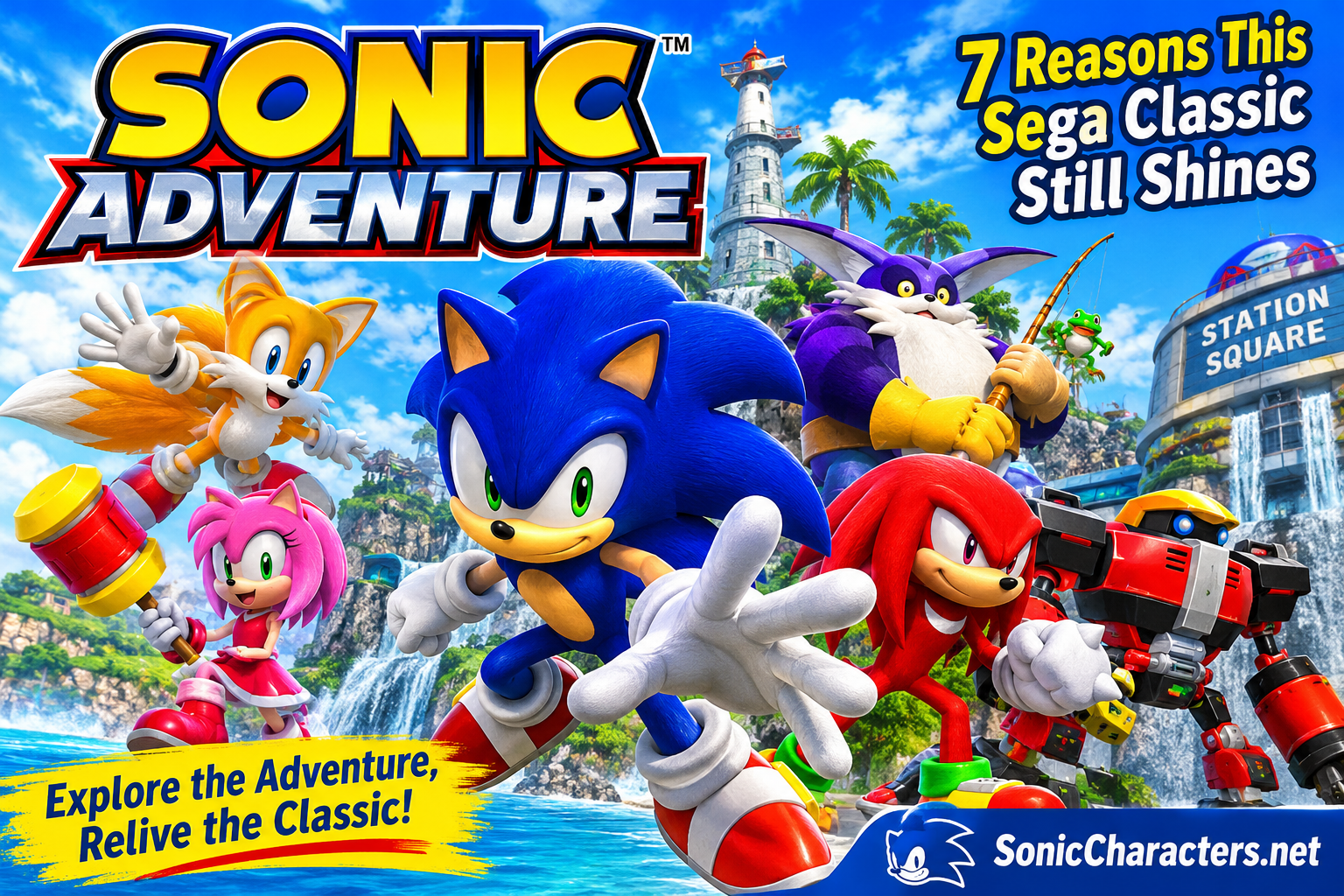
When people talk about memorable platform games, Sonic Adventure deserves a place in the conversation. Released in 1998 for the Sega Dreamcast, this title introduced a completely different experience for fans of the blue hedgehog. Instead of keeping Sonic inside traditional side-scrolling levels, the developers created a colorful three-dimensional world filled with exploration, fast movement, interesting characters, and exciting challenges.
Developed by Sonic Team and published by Sega, Sonic Adventure represented an important step forward for the franchise. It was the first mainline Sonic the Hedgehog game built specifically around 3D gameplay. The change gave players an opportunity to experience familiar characters from a new perspective while discovering larger environments and following a connected story.
Even years after its original release, Sonic Adventure continues to attract attention from longtime fans and newer players. Its unique atmosphere, memorable soundtrack, and different gameplay styles make it an interesting part of gaming history. Whether someone remembers playing it on the Dreamcast or is discovering it through a later version, there are plenty of reasons to appreciate what this classic adventure offers.
1. The Beginning of a New 3D Sonic Experience
Moving a character from a two-dimensional environment into a three-dimensional world is not a simple task. Sonic had always been associated with speed, quick reactions, and colorful side-scrolling stages. Bringing those qualities into a larger 3D environment required a different approach to level design and movement.
Sonic Adventure introduced players to that new direction. Instead of traveling only from left to right, players could explore different paths, move through open areas, and experience stages from multiple camera angles.
The developers wanted to preserve the energetic feeling associated with earlier Sonic games while making the experience feel modern for its time. This combination created something that was different from the previous entries.
The transition was especially exciting because the Dreamcast allowed developers to create more detailed environments and character models. For players in the late 1990s, seeing Sonic move through fully three-dimensional locations was a memorable experience.
Although the technology and controls reflected the limitations of that era, the game helped establish a new direction for future Sonic titles.
2. An Interesting Story Featuring Multiple Characters
One of the most recognizable features of Sonic Adventure is its storytelling approach. Rather than following only Sonic from beginning to end, the game allows players to experience events through several different characters.
The main adventure includes Sonic, Tails, Knuckles, Amy Rose, Big the Cat, and E-102 Gamma. Each character has a different personality, objective, and connection to the central storyline.
The story revolves around an ancient creature known as Chaos. After being awakened, Chaos becomes increasingly powerful and creates serious problems for the world. Sonic and his friends must discover the truth behind the creature and stop the threat from becoming even greater.
What makes this storytelling style interesting is how the different character campaigns connect. Players gradually discover additional information by completing individual stories.
Sonic focuses on speed and action, while Tails has his own personal journey involving confidence and independence. Knuckles searches for the missing pieces of the Master Emerald, and Amy becomes involved in a rescue mission.
These separate experiences give the adventure a larger scope. Instead of presenting one straightforward journey, the developers created several perspectives that contribute to the same overall narrative.
3. Beautiful and Memorable Locations
Exploration is another reason Sonic Adventure remains memorable. Its environments include tropical beaches, ancient ruins, busy cities, mysterious forests, and unusual futuristic locations.
Station Square is one of the main areas where players can explore, discover characters, and move between different parts of the adventure. The city gives the game a recognizable urban atmosphere that contrasts with its more traditional Sonic environments.
The Mystic Ruins provide a different feeling. Surrounded by natural landscapes and ancient structures, this area introduces players to the mysterious history connected to the storyline.
The Egg Carrier is another important location. This enormous flying machine creates a different atmosphere and connects several major events throughout the adventure.
Each location contributes something different to the overall experience. Some areas emphasize exploration, while others are designed around speed, platforming, or story progression.
The variety makes Sonic Adventure feel like a journey through several different worlds rather than a collection of unrelated levels.
4. Different Gameplay Styles Keep the Adventure Interesting
A major feature of Sonic Adventure is that every playable character has a different gameplay style. This decision gives players more variety and allows them to approach the same overall story from different perspectives.
Sonic’s stages are mainly focused on speed, jumping, and reaching the finish line. His levels are designed to create excitement through loops, ramps, springs, and fast-moving pathways.
Tails has a different objective. His gameplay often involves flying and racing against another character. Instead of simply reaching the end of a stage, players must use his abilities carefully to complete challenges.
Knuckles focuses on searching for pieces of the Master Emerald. His missions involve exploring environments, climbing surfaces, gliding, and locating hidden objects.
Amy Rose uses a hammer to defend herself while avoiding enemies. Her stages focus more on movement, timing, and escaping dangerous situations.
Big the Cat has a fishing-based gameplay style. Players search for Froggy and use fishing mechanics to complete their objectives.
Finally, E-102 Gamma offers a combat-oriented experience. His missions involve shooting targets and completing objectives within a limited amount of time.
These differences make the game feel varied, although not every gameplay style will appeal equally to every player.
5. Sonic’s Speed Creates Exciting Moments
Speed has always been an important part of Sonic’s identity, and Sonic Adventure attempts to bring that feeling into a three-dimensional environment.
The game includes several stages where players can move at incredible speeds while avoiding obstacles and collecting rings. The combination of movement, jumping, and carefully designed pathways creates exciting sequences.
One particularly memorable example is the opening stage, Emerald Coast. Its beach setting introduces the player to the game’s movement system and quickly demonstrates how different the 3D experience can feel.
Other stages include large loops, steep slopes, narrow pathways, and unexpected turns. Players must react quickly to avoid falling or losing momentum.
However, speed is not the only important element. Learning how to control Sonic, understanding the camera, and recognizing the layout of each stage are also essential.
This balance between fast action and player control is part of what makes the experience interesting.
6. A Soundtrack That Gives Every Area Its Own Identity
Music plays a major role in creating the atmosphere of Sonic Adventure. The soundtrack includes energetic rock songs, electronic sounds, relaxing background music, and character-specific themes.
Sonic’s main theme, Believe in Myself for Tails, and It Doesn’t Matter are examples of songs that help establish the personalities of different characters.
The stage music also contributes to the atmosphere. Fast-paced tracks make action sequences feel more exciting, while quieter compositions give exploration areas a different mood.
The soundtrack reflects the musical style popular in late-1990s video games while giving the Sonic franchise its own recognizable identity.
For many longtime players, hearing these songs brings back memories of discovering the Dreamcast adventure for the first time.
Music is not simply something playing in the background. It becomes part of the overall experience and helps make individual stages more memorable.
7. The Dreamcast Helped Make the Game Stand Out
The Sega Dreamcast was an important console in gaming history. It introduced several technical improvements and allowed developers to experiment with more advanced 3D experiences.
Sonic Adventure became one of the system’s most recognizable titles. Its detailed character models, animated cutscenes, large environments, and fast gameplay helped demonstrate what the console could offer.
At the time, the transition from older 2D Sonic games to a fully three-dimensional adventure felt significant.
The Dreamcast version also included the Chao Garden, a feature that became especially popular among fans.
Players could interact with small creatures called Chao, raise them, provide care, and influence their development. This peaceful activity offered a break from the main action.
The Chao Garden became one of the most loved additional features because it gave players something different to enjoy outside the regular stages.
Exploring the Chao Garden
The Chao Garden deserves special attention because it provides a completely different experience from the main adventure.
Instead of running through dangerous environments or fighting enemies, players can spend time looking after their Chao. These small creatures respond to their surroundings and can develop different characteristics depending on how they are raised.
Players can collect animals and items during stages and use them to influence their Chao’s development. Over time, these creatures can become stronger and develop different appearances.
The garden is a relaxing activity that encourages experimentation. Some players enjoy discovering how different combinations of items affect their Chao, while others simply enjoy watching them interact.
This feature helped give Sonic Adventure additional replay value. Even after completing the main story, there were still enjoyable activities waiting outside the traditional platforming experience.
The Importance of Chaos in the Story
Chaos is one of the central characters in Sonic Adventure. Unlike many traditional Sonic enemies, Chaos has a mysterious background connected to ancient history and the Master Emerald.
As the story develops, players discover more about its origins and the events that led to its awakening.
Chaos is not simply a creature that appears to create trouble. Its background introduces themes involving friendship, responsibility, ancient civilizations, and the consequences of human actions.
The character also changes throughout the adventure. Different forms appear as the story progresses, creating a growing sense of danger.
This storyline gives the adventure more emotional depth than a simple battle between Sonic and Dr. Eggman.
It also connects the modern characters with the ancient history of the world, making the setting feel larger and more developed.
Dr. Eggman’s Role in the Adventure
Dr. Eggman remains one of the most recognizable villains in the Sonic franchise. In Sonic Adventure, he continues his attempts to take control of the world through advanced technology and dangerous plans.
His connection to Chaos makes the storyline more complicated. Rather than relying only on his traditional machines, Eggman attempts to use the creature’s power to achieve his ambitions.
Throughout the game, Sonic and his friends encounter different robots, machines, and obstacles connected to Eggman’s plans.
His personality also provides moments of humor. Despite his intelligence and technological skills, his confidence sometimes causes him to underestimate his opponents.
This familiar combination of comedy and villainy helps preserve the traditional Sonic atmosphere while supporting a more ambitious storyline.
What Makes Sonic Adventure Different From Other Platform Games?
Many platform games focus mainly on completing stages and collecting items. Sonic Adventure includes those familiar elements but combines them with exploration, storytelling, character progression, and additional activities.
The adventure fields connect different parts of the world and allow players to discover new objectives. These areas create a sense of movement between the individual action stages.
The multiple-character system also changes how the game feels. Players are not restricted to one style of gameplay throughout the entire experience.
Some missions require speed and precision, while others encourage exploration or strategic movement.
The Chao Garden provides another layer of variety, allowing players to enjoy a more peaceful activity whenever they want a break from the main storyline.
This combination makes the experience stand out among many platform games released during the same period.
How Sonic Adventure Influenced Later Sonic Games
The success and popularity of Sonic Adventure helped establish important ideas for future entries in the franchise.
Its 3D movement system became a foundation for later experiments with three-dimensional Sonic gameplay. Future titles continued exploring larger environments, different camera perspectives, and new ways of presenting Sonic’s speed.
The game also demonstrated that Sonic stories could include multiple playable characters with individual objectives.
Some of these ideas were expanded in Sonic Adventure 2, which introduced a different structure and additional gameplay mechanics.
Although later Sonic games took different creative directions, the original adventure remained an important reference point for fans and developers.
Its influence can be seen in discussions about the franchise’s transition into modern 3D gaming.
Is Sonic Adventure Still Worth Playing Today?
For players who enjoy classic platform games, Sonic Adventure can still provide an interesting experience.
Its graphics and controls may feel dated compared with modern releases, but its atmosphere and character variety continue to offer something special.
New players should approach the game with an understanding that it reflects the technology and design choices of the late 1990s.
The camera system can sometimes be challenging, and certain character missions feel very different from traditional Sonic gameplay. However, these features are also part of the game’s identity.
Longtime fans may appreciate revisiting familiar locations, listening to the soundtrack, and experiencing the story again.
Newer players can explore an important chapter in the history of one of gaming’s most recognizable franchises.
Final Thoughts
Sonic Adventure represents an important moment in the history of Sega and the Sonic the Hedgehog franchise. Its transition into three-dimensional gameplay introduced a new way to experience the blue hedgehog while combining fast platforming, character-based stories, exploration, and memorable music.
From the exciting Emerald Coast stages to the peaceful Chao Garden, the game offers a variety of activities that make the adventure feel distinctive.
Its different characters, mysterious storyline, and memorable locations helped create an experience that fans continue discussing many years after its original release.
Although modern games offer more advanced graphics and technology, the original Sonic Adventure still has a special place in gaming history. It reminds players of a time when developers were experimenting with new ideas and discovering what a 3D Sonic game could become.
For anyone interested in the history of platform gaming, this Sega classic remains an adventure worth exploring.