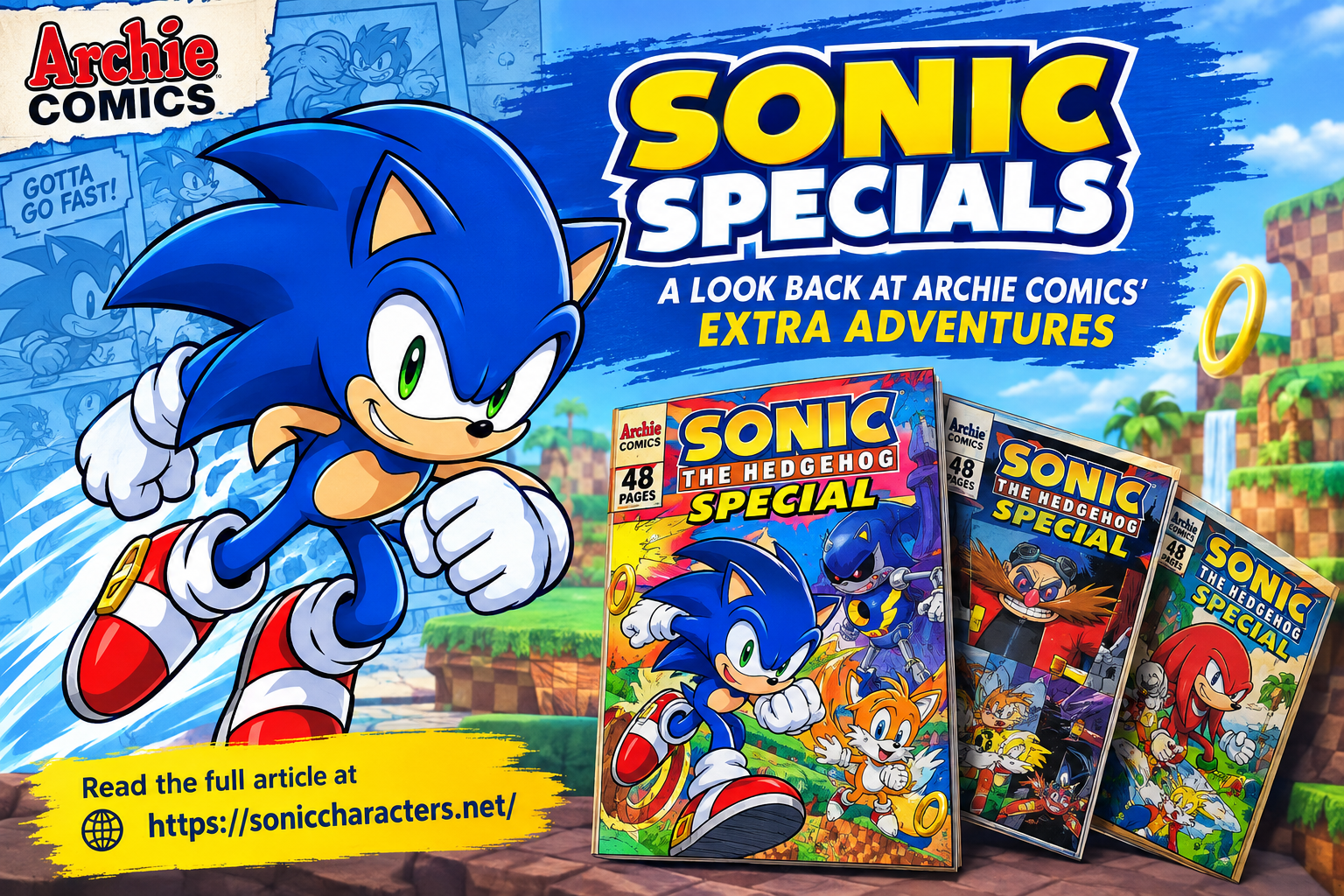
The history of Sonic the Hedgehog is filled with memorable games, characters, television appearances, merchandise, and comics. While many fans first discovered Sonic through a video-game console, the character quickly became much bigger than gaming alone. During the 1990s, Archie Comics played an important role in expanding Sonic’s world through its comic-book publications. Alongside the regular series, readers were also treated to a collection of longer releases known as Sonic Specials.
The Sonic Specials were individual 48-page Sonic the Hedgehog comics published by Archie Comics every couple of months between December 1994 and 1996. They arrived during an especially interesting period for the Sonic franchise, when the blue hedgehog was becoming one of the most recognizable characters in popular entertainment.
Unlike a normal monthly comic issue, these specials provided additional room for storytelling. Their longer format allowed writers and artists to develop adventures with more scenes, character interactions, action, and world-building. For fans at the time, each new special was another opportunity to spend more time inside the expanding Sonic universe.
What Made Sonic Specials Different?
The most obvious feature of the Sonic Specials was their length. At 48 pages, they were considerably more substantial than a standard comic issue. That extra space gave the creative team greater flexibility when developing stories.
A typical short comic has to move quickly from its opening scene to the main conflict and eventually to a conclusion. With additional pages available, a special could take its time. Characters could have longer conversations, action sequences could receive more attention, and secondary elements of a story could be explored without making the entire issue feel rushed.
This difference helped give the specials their own identity within Archie’s Sonic publishing lineup. They were not simply another regular issue with a different cover. They represented an opportunity to present a larger Sonic adventure.
The Mid-1990s Sonic Era
To understand the appeal of the specials, it helps to consider when they were released. The middle of the 1990s was an exciting period for Sonic fans.
Sonic had already established himself as a major video-game character, but his popularity continued to grow. New games were arriving, television adaptations were reaching audiences, and merchandise was appearing everywhere. At the same time, comic books gave fans another way to follow the character.
Archie Comics had developed a particular interpretation of the Sonic universe. The comic stories could explore ideas and relationships in ways that were different from what players experienced in the games. Readers could become familiar with recurring characters and follow ongoing developments from issue to issue.
The Sonic Specials fit naturally into this environment. They provided additional stories at a time when there was already a strong audience interested in reading more about Sonic.
Why the 48-Page Format Was Important
Page count might sound like a small detail, but it can make a major difference in comics. A longer story has more room to establish its setting, introduce a problem, develop characters, and bring the adventure to a satisfying ending.
For Sonic, this was particularly useful because his comic world had become increasingly detailed. There were heroes, villains, allies, rivals, and supporting characters who could all contribute to a story.
A 48-page format could give these elements breathing room. Instead of jumping immediately between scenes, the creative team could build momentum. Readers could experience the adventure at a more comfortable pace while still getting the energetic action expected from a Sonic story.
The additional pages also gave artists more opportunities to show off the characters. Sonic comics depend heavily on movement and visual energy, so having extra space for chase scenes, battles, dramatic moments, and expressive character art could make a noticeable difference.
Sonic Beyond the Video Games
One of the most interesting things about Archie’s Sonic comics is the way they demonstrated the flexibility of the character. Sonic was created as a video-game hero, but the basic idea of a fast-moving hero with a recognizable personality works equally well in comic storytelling.
Comics can provide details that a game cannot always communicate. A video game focuses heavily on gameplay, levels, challenges, and player interaction. A comic, on the other hand, can concentrate on conversations, relationships, personalities, and extended plotlines.
This made the Archie publications valuable to fans who wanted to experience Sonic in a different way.
The Sonic Specials contributed to that broader experience. Their longer stories gave readers another reason to explore the comic version of Sonic rather than treating the books as simple adaptations of the games.
A Snapshot of 1990s Comic Culture
Looking at the Sonic Specials today also provides an interesting glimpse into 1990s comic-book culture. Printed comics were an important part of how fans discovered and followed their favorite characters.
There was something special about finding a new issue at a comic shop, bookstore, newsstand, or other retail location. Before digital comics and instant online updates became common, physical publications were a major connection between fans and fictional worlds.
The specials benefited from that environment. Their larger size made them stand out, and their occasional release schedule meant that fans had something extra to anticipate.
For modern readers, these comics can therefore be appreciated on two levels. They are Sonic stories, but they are also artifacts from a particular period in publishing and entertainment history.
The Collecting Appeal
Older Sonic comics have become interesting collectibles for fans who enjoy preserving the history of the franchise. The Sonic Specials are especially appealing because of their distinct format and their release period.
Collectors may be interested in the cover artwork, condition, publication details, individual stories, or simply the nostalgia associated with finding older Sonic material.
For someone who grew up with Sonic during the 1990s, coming across one of these comics can bring back memories of a very different entertainment landscape. For newer fans, collecting them can be a way to understand how Sonic developed outside the games.
The physical nature of older comics adds another dimension to the experience. Holding a publication from the 1990s feels different from reading a digital page on a modern device. The paper, artwork, advertisements, cover design, and printing style all contribute to its historical character.
Why Longer Sonic Stories Matter
A character as recognizable as Sonic can easily become associated with speed alone. After all, running quickly is one of his defining traits. But good storytelling requires more than action.
Longer comic stories can show why characters behave in certain ways, how friendships develop, and what motivates conflicts. They can create situations where the reader becomes invested in the outcome rather than simply watching Sonic race from one location to another.
The extra length of the specials offered an opportunity for that kind of storytelling. While action remained an important part of the Sonic experience, the format allowed stories to explore additional ideas around the characters and their world.
That balance between action and storytelling is part of what makes older Sonic comics worth revisiting.
Sonic Specials and Fan Nostalgia
Nostalgia has played a major role in keeping interest in 1990s Sonic media alive. Fans who experienced the franchise during that period often remember more than just the games. They remember cartoons, toys, magazines, comics, and the excitement surrounding every new Sonic release.
The Sonic Specials belong to that collection of memories.
Their publication between December 1994 and 1996 places them firmly within a formative period for Sonic fandom. The franchise was changing quickly, and every new medium added another layer to the character’s growing identity.
For longtime fans, the specials can represent a connection to that era. For newer fans, they offer a chance to look back and see how Sonic’s comic-book world developed during an important stage of the franchise.
The Lasting Value of Archie’s Sonic Publications
Archie Comics’ Sonic material remains an important part of Sonic history because it helped demonstrate that the character could support stories beyond the boundaries of video games.
The comics created a space where Sonic could participate in longer narratives and where readers could become attached to a wider cast of characters. The Sonic Specials strengthened that approach by offering larger individual publications rather than relying exclusively on the standard comic format.
Even decades later, these books remain interesting to readers who want to understand the evolution of Sonic in print.
They also show how entertainment franchises were built before social media and digital platforms dominated fan culture. Publishers relied on printed material to maintain interest, while fans collected issues and shared their enthusiasm through personal communities.
Final Thoughts
The Sonic Specials hold a distinctive position in the history of Archie Comics’ Sonic the Hedgehog publications. Released as individual 48-page comics every couple of months between December 1994 and 1996, they gave readers longer adventures during one of the most exciting periods in Sonic’s development.
Their importance is not simply about having more pages. These specials represent an era when Sonic was expanding rapidly across different forms of entertainment. They provided comic readers with additional stories, gave creative teams more room to work, and helped strengthen the larger world surrounding the famous blue hedgehog.
For collectors, they are pieces of 1990s comic history. For longtime Sonic fans, they can be reminders of childhood and a memorable era of the franchise. And for newer readers, they provide an opportunity to explore how Sonic’s identity developed beyond the screen.
The Sonic Specials may belong to an earlier chapter of Sonic’s publishing history, but they remain an interesting part of the journey that turned a video-game mascot into a character with a lasting presence across generations.