Anime adaptations of video game franchises often face a difficult challenge. They must introduce familiar characters to new viewers while giving longtime fans something exciting to enjoy. Some adaptations struggle to balance these expectations, but Sonic X found an interesting way to bring the world of Sonic the Hedgehog into television animation.
First released in Japan in April 2003, Sonic X became an important animated chapter in the history of Sega’s famous blue hedgehog. The series combined action, comedy, friendship, science fiction, and emotional storytelling. It followed Sonic and his friends after an unexpected incident transported them from their familiar world to Earth, where they encountered humans and became involved in adventures that reached far beyond their original surroundings.
The Japanese television series originally ran for 52 episodes, concluding in March 2004. Its international releases helped introduce the characters to a wider audience, making the show particularly memorable for viewers who discovered Sonic through television rather than video games.
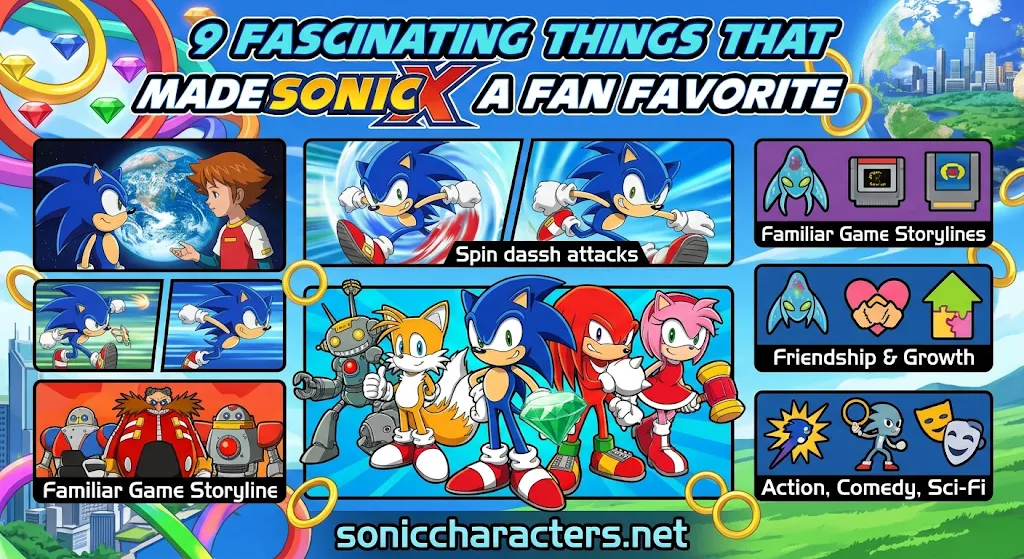
What made this animated adventure interesting was not simply its colorful action scenes. Its characters, relationships, familiar game references, and different storytelling approach gave audiences several reasons to keep watching.
1. How Sonic X Brought the Video Game World to Television
Adapting a video game into an animated series requires more than copying its characters and locations. Television needs continuing stories, meaningful conversations, and situations that allow characters to develop over time.
Sonic X approached this challenge by placing Sonic and his friends in a completely different environment. Instead of keeping every adventure inside their usual world, the story introduced a situation in which the characters found themselves on Earth.
This decision created opportunities for humor, misunderstandings, friendships, and exciting encounters. Sonic was still the fast-moving hero fans recognized, but his surroundings introduced new challenges that were different from those in the games.
The anime also included familiar elements from the franchise. Viewers could recognize the personalities of Sonic, Tails, Knuckles, Amy Rose, and other established characters. Their interactions helped maintain a connection with the original games while allowing the television series to explore additional ideas.
For longtime fans, this mixture of familiar characters and new situations made the adaptation interesting. New viewers could also understand the basic adventure without needing extensive knowledge of the video game franchise.
2. The Unexpected Journey That Introduces Sonic to Earth
One of the most recognizable aspects of the story is the way Sonic and his friends become separated from their original environment and arrive in the human world.
The incident changes the direction of their adventure. They must understand unfamiliar surroundings, deal with human society, and discover how to return home. Their new circumstances create both entertaining moments and serious challenges.
A young human character named Chris Thorndyke becomes an important part of this storyline. His meeting with Sonic develops into a friendship that influences many of the events throughout the series.
Chris provides a human perspective on the extraordinary events taking place around him. While Sonic is accustomed to dangerous adventures, Chris experiences many of these situations as something completely new.
Their friendship gives the story an additional emotional dimension. It explores how people from very different backgrounds can develop trust and understanding.
The Earth setting also allows the writers to introduce different locations, human characters, and conflicts. Rather than repeating the same formula in every episode, the anime uses its new environment to create different types of adventures.
3. Sonic’s Personality Remains at the Center of the Story
A successful adaptation must preserve the qualities that make its main character recognizable. Sonic’s personality is one of the strongest elements of the anime.
He is confident, energetic, independent, and always ready to move toward his next adventure. His love of speed is obvious, but his personality involves much more than running quickly.
Sonic dislikes unnecessary restrictions and prefers making his own decisions. However, his confidence does not prevent him from caring about his friends. When someone needs help, he is usually willing to take action.
In Sonic X, these characteristics become important throughout the story. His attitude creates humorous situations, especially when he encounters people who do not understand his unusual abilities or adventurous lifestyle.
His confidence also creates tension with enemies who believe they can control or defeat him. Rather than allowing difficult situations to discourage him, Sonic usually responds with determination.
Another interesting part of his character is his relationship with freedom. He enjoys exploring new places and does not like being trapped in situations where others control his choices.
These qualities help maintain the spirit of the original video game character while giving the anime room to develop longer stories.
4. Tails, Knuckles, and Amy Bring Different Personalities
Sonic may be the central character, but his friends play an equally important role in creating an entertaining group dynamic.
Tails is known for his intelligence, mechanical knowledge, and loyalty. His ability to fly using his two tails makes him useful during dangerous situations. In the anime, his technical skills often help the group overcome problems that cannot be solved through speed or physical strength alone.
Knuckles offers a different personality. He is strong, serious, and sometimes stubborn. His responsibility toward protecting the Master Emerald influences many of his decisions. Although he occasionally disagrees with Sonic, his commitment to protecting others makes him a valuable member of the group.
Amy Rose brings enthusiasm, confidence, and emotional energy to the adventure. Her affection for Sonic creates several amusing interactions, but her character is not limited to romantic comedy. She can also be brave, determined, and supportive when her friends face difficult circumstances.
Together, these characters create a balanced team. Each one contributes something different, allowing the anime to explore friendship, disagreements, cooperation, and personal responsibility.
Their personalities also help the show appeal to different audiences. Some viewers enjoy Tails’ inventions, while others prefer Knuckles’ strength or Amy’s energetic personality.
5. Dr. Eggman Makes Every Conflict More Interesting
No Sonic adventure would feel complete without a memorable antagonist. Dr. Eggman plays a major role in the anime, bringing his familiar ambition and unusual inventions into the television storyline.
His goal of gaining control and defeating Sonic creates many of the conflicts that move the story forward. He frequently uses machines, robots, and complicated plans to achieve his objectives.
However, Eggman is not simply a serious villain. His exaggerated personality, dramatic reactions, and occasional mistakes create comedy throughout the series.
His relationship with Sonic is especially entertaining because both characters have strong personalities. Sonic prefers freedom and spontaneous action, while Eggman depends on planning, technology, and control.
This contrast produces an interesting rivalry. Even when Eggman believes he has created the perfect plan, Sonic often finds a way to interfere.
The anime also gives Eggman opportunities to interact with other characters. These moments make his role more varied than simply appearing at the end of an episode as the main enemy.
His presence connects the television series with the familiar conflicts that audiences already recognize from the games.
6. Familiar Video Game Adventures Become Animated Stories
Another reason viewers remember the anime is its connection to several important Sonic video game storylines.
Rather than developing an entirely unrelated adventure, the series incorporates recognizable characters, locations, and events from the franchise.
Some story elements draw inspiration from games such as Sonic Adventure and Sonic Adventure 2. This gives longtime fans opportunities to recognize familiar moments while experiencing them through animation.
The inclusion of Chaos and the Master Emerald adds another connection to the established Sonic universe. These elements are important because they bring a sense of continuity between the games and the television adaptation.
The anime can also spend more time developing conversations and relationships than a typical action game. Television allows characters to explain their motivations, respond to unexpected events, and build connections through repeated interactions.
This difference makes the adaptation interesting even for people who already know the original stories.
For viewers unfamiliar with the games, these references are presented as part of the larger adventure rather than requiring them to understand every detail beforehand.
7. Animation, Action, and Music Create a Distinct Experience
The visual presentation is another important part of the series. Its colorful environments, recognizable character designs, and fast-moving action sequences help capture the energetic atmosphere associated with Sonic.
The animation gives the characters opportunities to express their personalities through movement and facial expressions. Sonic’s speed, Tails’ flying abilities, and Knuckles’ physical strength are particularly effective when presented through animated action.
The different environments also help maintain visual variety. Earth-based locations create a contrast with the more familiar settings associated with the Sonic universe.
Music contributes significantly to the experience. Background tracks support dramatic moments, exciting encounters, and emotional scenes. The opening and ending themes also help establish the identity of the television series.
International audiences may remember different versions of the soundtrack and voice performances because the show received different regional releases and adaptations.
The English-language version introduced changes that distinguished it from the original Japanese broadcast. These differences became part of the experience for viewers who watched the series through international television programming.
Although animation technology and television production styles have changed considerably since 2003, the show’s presentation remains recognizable to fans of early 2000s anime.
8. Friendship and Personal Growth Give the Story Emotional Value
Action and comedy attract viewers, but emotional storytelling can make an animated series memorable long after its original broadcast.
Sonic X uses friendship as one of its central themes. Sonic and his companions frequently face situations in which individual abilities are not enough to solve a problem.
They must learn to trust each other, cooperate, and recognize the importance of their relationships.
Chris Thorndyke’s involvement adds another perspective to this theme. His friendship with Sonic develops through shared experiences, challenges, and moments of mutual understanding.
The series also explores the difficulties of living in unfamiliar circumstances. Sonic and his friends must adjust to Earth, while Chris becomes involved in a world that is far beyond his ordinary experiences.
These circumstances create opportunities for personal growth. Characters learn from their mistakes, develop stronger relationships, and discover that friendship requires more than simply enjoying good times together.
The emotional side of the anime helps balance its action-oriented storytelling. It gives audiences reasons to care about the characters beyond their abilities and appearances.
9. Why Sonic X Still Matters to Longtime Fans
Animated television series can become important parts of a franchise’s history even after their original broadcasts have ended.
For many viewers, Sonic X represents a memorable period when the Sonic universe expanded into different forms of entertainment. It introduced animated versions of familiar characters to audiences who might not have followed every video game release.
Its combination of recognizable characters, science fiction, humor, and emotional storytelling helped it develop a distinct identity.
The show also provided a different interpretation of the franchise. Video games generally focus on interactive challenges, movement, and player progression. Television animation offers opportunities for longer conversations, supporting characters, and stories that unfold across multiple episodes.
This difference allowed the series to explore ideas that could not always receive the same attention in a traditional game.
Nostalgia is another reason people continue discussing it. Viewers who watched the anime during their childhood may remember its characters, opening sequences, dramatic moments, and weekly television broadcasts.
New generations can approach it from a different perspective, discovering how an early 2000s anime interpreted a famous video game franchise.
The continued interest in Sonic-related animation demonstrates how adaptable the characters can be across different entertainment formats.
The Difference Between the Japanese and International Versions
One detail worth understanding is that the original Japanese broadcast and international releases were not identical.
The Japanese version consisted of 52 episodes and aired between April 2003 and March 2004. The English-language adaptation produced by 4Kids Entertainment was edited and presented differently.
International broadcasts also included additional episodes numbered 53 through 78, adapting story material from the original Japanese series.
This explains why some viewers remember different episode totals when discussing the show.
The changes between versions also involved dialogue, music, editing, and presentation. Consequently, someone watching the original Japanese release may notice differences compared with the English-language version they remember from television.
Understanding this distinction helps avoid confusion when researching the anime’s history or comparing episode guides.
What Makes the Series Worth Revisiting Today?
Revisiting an older animated series can be an enjoyable way to understand how a popular franchise developed over time.
Sonic X offers a combination of familiar characters and a different storytelling environment. It gives Sonic and his friends opportunities to interact with humans, experience unfamiliar situations, and participate in adventures that extend beyond the structure of a typical video game.
Its early 2000s presentation may feel different from modern animation, but that is also part of its appeal. The character designs, storytelling style, soundtrack, and pacing reflect the period in which the series was produced.
For longtime fans, watching it again can bring back memories of discovering Sonic through television. For newer viewers, it provides an opportunity to explore another interpretation of the characters.
It is also interesting to compare the anime with other animated projects based on the franchise. Each adaptation approaches Sonic differently, demonstrating how the same characters can support different styles of storytelling.
Final Thoughts
Sonic X remains an interesting part of the Sonic the Hedgehog franchise because it successfully brought familiar video game characters into a different entertainment format. Its story combined adventure, humor, science fiction, friendship, and recognizable references to the games.
The arrival of Sonic and his companions on Earth created opportunities for new relationships and unexpected challenges. Meanwhile, characters such as Tails, Knuckles, Amy Rose, and Dr. Eggman helped maintain the personality and excitement that fans associate with the franchise.
Although its original Japanese broadcast consisted of 52 episodes, its international releases introduced the series to even more viewers. Its influence on the memories of longtime fans demonstrates the lasting appeal of animated adaptations.
Whether someone remembers watching it years ago or is discovering it for the first time, the series offers an enjoyable look at how a beloved video game world can become a television adventure.